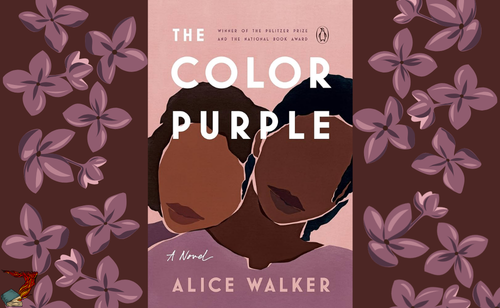
The Color Purple by Alice Walker was published in 1982. It was awarded the Pulitzer Prize for Fiction 1983.
BANNED in Clay, Collier, Hillsborough, Indian River, Lee, Martin, Orange, Union and Volusia County public schools
The Color Purple is a series of letters from Celie to God and her estranged sister, Nettie. The daughter of 1930s Georgia sharecroppers, Celie endures abuse, racism and sexism. Through her letters, she slowly claims a future for herself.
For school boards across Florida, The Color Purple is obscene. It was widely banned in 2023 for its depictions of sexual abuse, violence and lesbianism. The Florida law that enabled these bans, HB 1069, was later struck down in a U.S. District Court.
For Alice Walker, The Color Purple is about ancestry. Walker’s grandmother was murdered by a man who wanted to be her lover. She says, “A lot of the things in The Color Purple happened to people in my family long before I was born.”
Walker believes this ancestral connection is why the novel still resonates with readers. Walker said, “It is fresh enough so that they can feel that visceral connection of ancestors. The distance between generations disappears, and I love that.”
The novel does resonate. In 1983, The Color Purple made Walker the first Black woman to win a Pulitzer Prize. In 1985, the novel was adapted into a film directed by Stephen Spielberg and nominated for 11 Academy Awards. A Broadway musical adaptation premiered in 2005 and was recently reimagined as a movie-musical in 2023.
In a 1983 NPR interview, Walker was asked about negative reactions to The Color Purple’s content. She responded, “One of the reasons I wanted to have strong, beautiful, wonderful women loving each other is because I think that people can deal with that. I have no fear whatsoever. I think that the people who are uptight and bigoted and afraid in their own lives will have difficulty.”