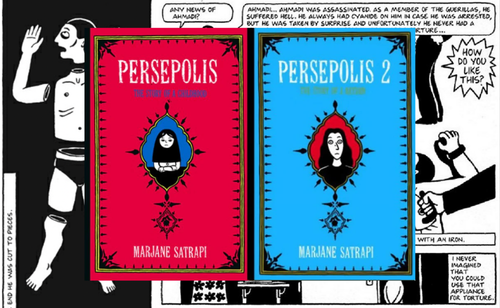
Persepolis and Persepolis 2 by Marjane Satrapi were published in 2003 and 2004, respectively. Persepolis was selected for the YALSA’s Best Books for Young Adults in 2004.
BANNED in Hillsborough, Indian River, Union and Volusia County schools
Persepolis is a Young Adult graphic memoir that recounts author Marjane Satrapi’s childhood in Tehran, Iran, during and after the Islamic Revolution. The memoir depicts the effects of war, political oppression, and religious extremism on everyday life. Persepolis 2 follows Marji’s teenage years in Austria and Iran, where she struggles with loneliness, cultural identity, and sexism. Both novels explore the fight for personal freedom under political and social oppression.
In March 2013, Persepolis was banned in several Chicago Public Schools (CPS). The controversy began when CPS administrator Chandra James objected to a scene depicting the torture of a political prisoner under the Shah’s regime. The scene is depicted in Satrapi’s black-and-white cartoon style. James ordered the book’s removal from all schools under her authority. CPS CEO Barbara Byrd-Bennett later attempted to identify the person who had recommended the book for school library adoption, writing in an email, “Someone is in jeopardy bc (o)f this. Need a name.”
The ban sparked immediate backlash. After seeing copies of Persepolis removed from their classroom, two Lane Tech High School seniors organized a protest that received national media attention. Satrapi criticized the decision, calling it “completely stupid” and comparing it to the censorship she had experienced in Iran. She praised the students for speaking out against the ban.
The controversy helped place Persepolis at the center of the national book-banning debate. In 2014, it became the second most banned book in U.S. schools. Nearly a decade later, it was swept into Florida’s wave of book bans, leading to its removal from four school districts between 2023 and 2025.
Satrapi died on June 4th, 2026, at age 56, leaving behind a body of work celebrated worldwide for its defense of freedom, human rights, and free expression. Today, Persepolis remains one of the most widely taught graphic memoirs in the U.S. and a powerful reminder of the importance of protecting the freedom to read.